

GMAT Newsletter Subscribe
Enter your email address below and subscribe to our newsletter

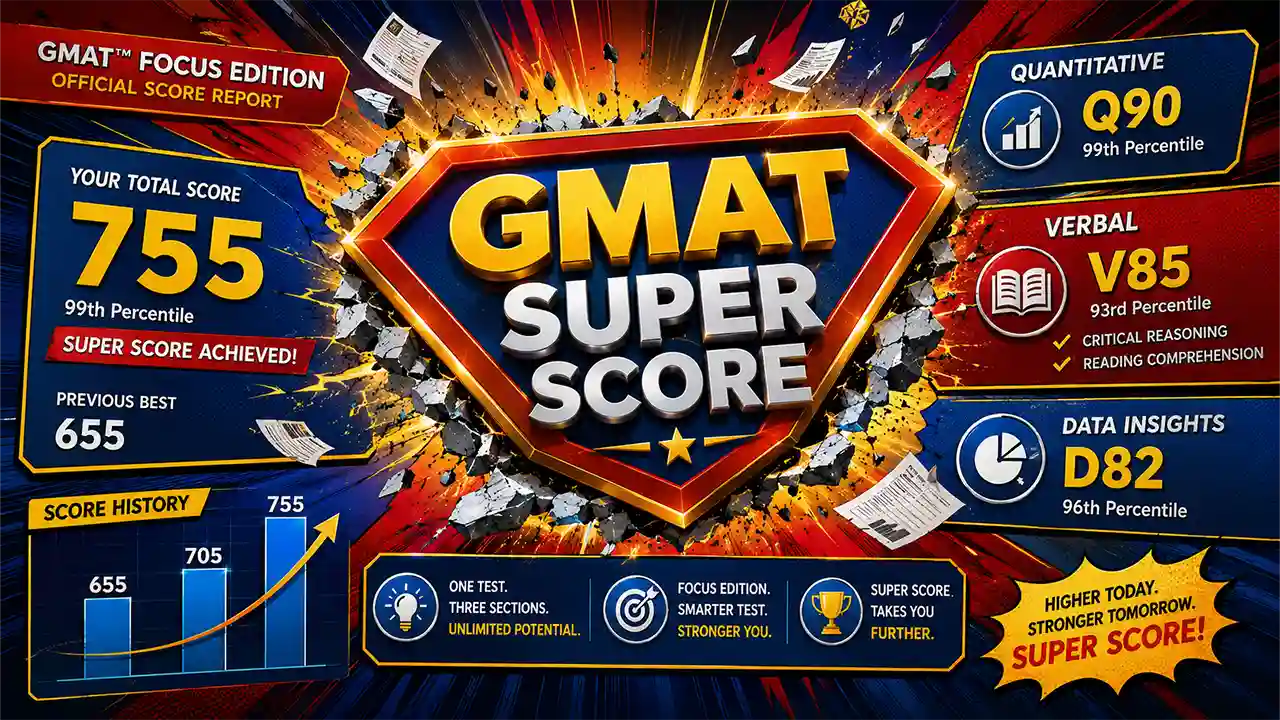
If you have been following GMAT news lately, you have almost certainly heard about the GMAT Superscore — and with good reason. GMAC rolled out this feature in August 2026, and it has the potential to change how thousands of Indian MBA aspirants think about their GMAT retake strategy, their score reporting, and ultimately their b-school applications.
In this post, we break down everything you need to know about the GMAT Super Score: what it is, how it is calculated, who is eligible, what schools will do with it, and — most importantly — whether it should change how you prepare.
The GMAT Superscore is an additional score data point that represents a test taker’s best aggregate performance across all valid GMAT exam attempts of the latest edition — whether taken at a test centre or online.
In simple terms: if you have written the GMAT more than once, the Super Score takes your highest section score in Quantitative Reasoning, your highest section score in Verbal Reasoning, and your highest section score in Data Insights — each potentially from different attempts — and combines them into a single, composite score.
This is not a new concept. Superscoring has existed in undergraduate admissions for years in the US and other western countries. The SAT and ACT have long used superscore models. TOEFL uses a superscore model for graduate admissions. GMAC is now applying the same logic to the GMAT Focus Edition.
Let’s use the example Swetha walks through in the video to make this concrete.
Say you write the GMAT for the first time and score:
It is a strong score, but you want to push your Data Insights higher. You spend three weeks on focused DI prep and write the GMAT again:
Now, your Superscore picks the best from each section across both attempts:
The GMAT will calculate what this combination of 87 + 85 + 85 translates to as a total score on the 205–805 scale, and include that figure on your score report alongside the actual attempt you are submitting to schools.
Per GMAC’s own research, candidates may see a 20–50 point increase between their single-attempt Total Score and their Superscore. That is a meaningful uplift on a 600-point scale.

Sign up for a demo class at https://wzko.in/demo, and begin your GMAT Preparation now!
1. The Superscore is auto-calculated — you do not opt in or out
The moment you write the GMAT a second time, GMAC auto-generates your Superscore. There is no toggle to switch it off. It will appear on your scorecard automatically. If you have written the GMAT only once, there is no Superscore — it simply does not apply.
2. The Superscore does not change your original scores
Your individual attempt scores remain exactly as they are. The Superscore is an additional metric, not a replacement. Every attempt and its associated sectional scores remain part of your score history. If you choose to send only one of your scores to a school, they will see only that score and the superscore.
3. It uses the same 205–805 scale as your GMAT Total Score
There is no new or unfamiliar scale to worry about. Schools already understand the GMAT scale, so the Super Score is immediately interpretable. Note: it does not carry an associated percentile ranking.
4. Ties in section scores go to the more recent attempt
If your highest section score appears in two different attempts (say, Quant: 87 in both Attempt 1 and Attempt 2), the score from your more recent attempt is used in the Superscore calculation.
5. The Superscore will always be equal to or higher than your submitted score
It can never be lower. If your single best attempt already contains your highest scores in every section, your Superscore equals your submitted score exactly.
This is an important distinction: only valid GMAT Focus Edition scores are eligible.
Expired GMAT Focus Edition scores are excluded. GMAT 10th Edition scores (the old format) are also excluded entirely — the exam structure was different, it had different sections, and there is no like-for-like comparison possible. So if you wrote the older GMAT and then switched to the Focus Edition, only your Focus Edition attempts count toward the Superscore.
The good news for Indian test-takers who have already written the GMAT Focus Edition once or twice before the Superscore was introduced: your existing valid scores will automatically be included in the Superscore calculation. You do not need to retake the exam just to be eligible.
This is the question everyone is asking — and the honest answer is: it depends on the school, and clarity is still emerging.
Historically, even before Superscore existed, different schools handled multiple GMAT attempts differently:
What GMAC is effectively doing is providing a standardized tool so that schools that wanted to do sectional-best analysis no longer have to do it manually. Schools may stick with their pre-existing policies, update their policies, or use the Superscore as one additional data point.
As the application cycle for 2026–27 progresses and schools update their admissions FAQs, we will get more clarity. Wizako will keep you updated as this evolves.
No. Absolutely not.
This is perhaps the most important practical takeaway from this entire discussion — and it is the one Swetha emphasises most strongly in the video.
A tempting but deeply flawed approach that some aspirants have already suggested: “Should I just prep for Quant, write the GMAT once, then prep for DI, write it again, and so on?” The logic sounds clever — you build a superscore section by section.
The problem: the primary metric schools look at is still one complete, coherent score report. If no single attempt stands out as strong, you have an impressive Superscore but no standout report to anchor your application. Schools want to see you perform well across all sections in a single sitting.
Your strategy should remain exactly what it has always been: prepare for all three sections thoroughly, write the GMAT when you feel ready, aim for your strongest possible complete score, and submit that. If the Superscore happens to be higher than the score you submit — great. Treat it as a bonus metric, not the target.
According to GMAC, score anxiety is one of the most significant barriers keeping qualified candidates from sending their scores to programs. Many test-takers who perform well enough simply do not send scores because they fear being judged negatively. The Super Score is designed to reduce that anxiety — when every attempt contributes to your strongest possible aggregate, you are more likely to test confidently, send scores willingly, and consider a wider range of programs.
| Feature | Detail |
|---|---|
| Launch timeline | Launched in August 2026 |
| Eligible scores | Valid GMAT Focus Edition scores only |
| Excluded scores | Expired Focus Edition; all 10th Edition scores |
| Score scale | 205–805 (same as GMAT Total Score) |
| Percentile ranking | Not applicable for Super Score |
| Opt-out | Not possible — auto-generated |
| Score impact | Can be 20–50 points higher than single-attempt score |
| Effect on original scores | None — original scores unchanged |
The GMAT Superscore is a meaningful feature — it gives schools a richer picture of your potential and rewards consistent effort across multiple attempts. For Indian test-takers who write the GMAT two or three times (which is common), this is a genuinely useful addition.
But it does not change the fundamentals. Prepare well. Target all three sections. Write the GMAT when you are ready. Submit your best complete score. The Super Score will take care of itself.
If you are targeting top global MBA programs from India — whether that is IIM Ahmedabad’s PGPX, ISB, or schools like Wharton, LBS, INSEAD, or NUS — your score strategy remains the same. A strong single-attempt score with a Superscore that reinforces it is the ideal scenario.
For structured GMAT prep — including live online classes, sectional workshops, and one-on-one tutoring with 99th percentile instructors — explore Wizako’s programmes:
🎓 Free GMAT Live Online Demo Class → https://wzko.in/demo
📞 One-on-One GMAT Tutoring → https://wzko.in/121